 Tribes of Rhombica™
Tribes of Rhombica: Life
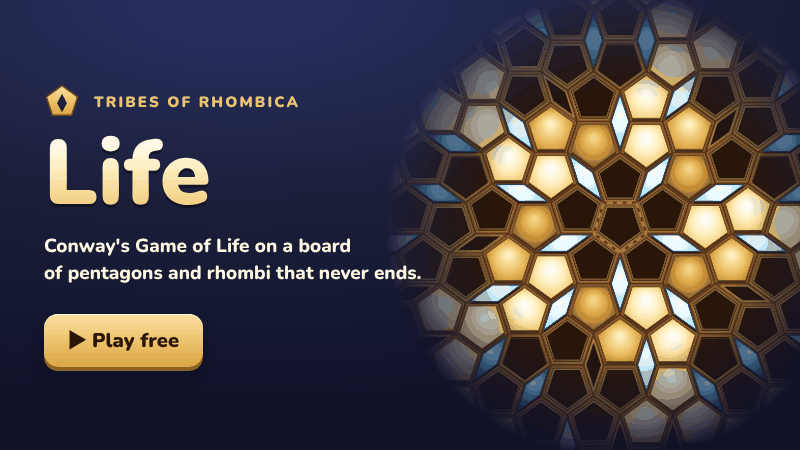
Conway's Game of Life on the pentagon-and-rhombus tiling of Rhombica Chess, grown into a board that never ends. Draw some life or roll a random start, pick how cells count their neighbours, set the birth and survival numbers, and watch what happens.
How it works
- Every cell is either alive or empty. Each generation, all cells change at the same time.
- An empty cell is born if its number of living neighbours is one of the birth numbers.
- A living cell survives if its number of living neighbours is one of the survival numbers; otherwise it dies.
- A rule is written B (born) / S (survives). John Conway's original Game of Life, on a square grid, is B3/S23.
Neighbours: edges or edges and corners
- Edges: a cell's neighbours are the cells that share a side with it. Pentagons have 5 and rhombi have 4.
- Edges + corners: every cell it touches, by a side or only at a corner, like a king in chess. Pentagons have 8, rhombi have 6, and the centre pentagon has 10.
- Each mode keeps its own rule, and you can change the numbers while it runs.
Presets
| Neighbours | Preset | Rule | What it does |
|---|---|---|---|
| Edges | Rhombica | B24/S145 | Wanders for about 150 generations, sometimes drifting away |
| Edges | Embers | B24/S034 | Burns down to small blinkers |
| Edges | Ripple | B2/S034 | Quick ripples that settle |
| Edges | Wildfire | B2/S23 | Usually spreads forever |
| Edges + corners | Rhombica | B37/S235 | Lively; bits can travel far |
| Edges + corners | Conway | B3/S23 | The original rule; on this board it dies out fast |
| Edges + corners | Coral | B35/S124 | Grows coral for about 100 generations |
| Edges + corners | Spread | B34/S236 | Slowly spreads forever |
An endless board
The board is the same tiling as Rhombica Chess, grown outwards from the centre pentagon one ring of tiles at a time, so it keeps its five-fold symmetry. The game only builds the tiles it needs: out to where your life has reached and what you're looking at. The pattern of pentagons and rhombi never repeats like a square grid does, so the same shape can behave differently in different places. The board reaches about 125 cells out from the centre in every direction (around 37,000 cells); if life ever gets that far, the game pauses and tells you. (The Rhombus Rush grid below needs no building at all, because it repeats.)
The Rhombus Rush grid and gliders
In the rules (⚙︎) you can switch the board to the Rhombus Rush grid, the board from Rhombus Rush: a point-up pentagon on a point-down one, with a thin rhombus standing between each pair. Unlike the chess board, this grid repeats forever, so a shape can come back exactly, shifted to a new spot. Such a shape is a glider, and it keeps travelling forever.
- With Edges, try the Gliders preset (B24/S034): random starts sometimes send 3-cell gliders flying. B2/S14 has a 6-cell glider that comes back every 12 generations.
- With Edges + corners, the Spray preset (B2/S6) sends tiny gliders off in every direction.
- On the chess board no glider has been found: its tiles never line up the same way twice, so the best a shape can do is drift a few cells and stop.
- The Glider Finder tries thousands of random starts and rules on the Rhombus Rush grid and lists every glider it finds. Press Open in Life on any of them to watch it fly in the game.
Starting a pattern
- Place life: tap or drag on the board. Tap a living cell to clear it. On the chess board, turn on 5-fold drawing to copy everything you draw around the centre five times.
- Random start: pick an area (Small, Medium, Large or Huge) and how full it is, then roll. Turn on 5-fold symmetric for a start that looks the same in all five directions; it stays symmetric as it runs.
- Changing cells by hand makes that the new generation 0, and Gen 0 takes you back to it.
- The game notices when everything dies, when the pattern stops changing (a still life), and when it starts repeating, and tells you after how many generations.
Tips
- Turn on Neighbour counts and zoom in to see why each cell lives or dies: gold numbers on empty cells mean a birth next turn, green on living cells means it survives, red means it dies.
- Small random starts often die out; try Large or Huge.
- Trails show where cells have just died, which makes moving shapes easy to follow.
- Press ⌖ to zoom to all the life; while it runs, the view follows it.
Controls
- Draw / Move: switch between drawing and moving around. On a phone, drag with two fingers to move and pinch to zoom; with a mouse, use the wheel to zoom and right-drag to move.
- Space play or pause, S or → one step, Z back to generation 0, R random start, C clear, 1–4 speed, D/V draw or move, + − zoom, F show all the life, M sound on or off.
More side games
Rhombus Rush
Magnetic falling blocks made of pentagons and rhombi. Clear rows, mind the charges.
Chess
Chess on a pentagon-shaped board of pentagons and rhombi. Play a friend, the computer or online.
Checkers
Checkers on the chess board, with flying kings. Play a friend, the computer or online.
Four
Drop pieces onto the pentagon board and get 4 in a row. Best of 3.
Tic-Tac-Toe
Three in a line on a tiny 11-cell pentagon board. Perfect play is a draw.
Snake
Classic snake on the pentagon-and-rhombus grid. Steer at any angle.
Cascade
Match-3 on the pentagon-and-rhombus grid, through all 10 tribe kingdoms. Endless levels.
Chinese Checkers
Race across a big pentagon board with 2 to 10 players. Hop chains, no captures.
Mines
Minesweeper on the pentagon-and-rhombus grid. Every board can be solved without guessing.
2048
Slide and merge tiles on the pentagon-and-rhombus grid. Swipe in any direction.
Dots & Boxes
Draw lines and close pentagons and rhombi to claim them. Play friends, the computer or online.
Reversi
Trap discs along queen lines on the chess board to flip them. Play a friend, the computer or online.
Lights
Lights Out on the chess board: tap to flip a cell and its neighbours. 30 levels and a daily puzzle.
Path
Draw one path through every cell of the chess board, visiting each exactly once. 30 levels and a daily puzzle.
▶ Play LifePlay Tribes of Rhombica
A side game made alongside Tribes of Rhombica, the free turn-based strategy game.